1st semester in review

This semester in english, I feel that I have improved a lot. One area I’ve seen improvement in is in class discussions. Towards the beginning of the year, I was very

Image result for discussion

hesistant to share thoughts with the class. As I progressed, I became more comfortable and began to share out more. This resulted in me understanding the topics better. Another area that I have improved is working with kids that I wouldn’t have chosen to work with. The book club project placed me in a group that I wasn’t very comfortable with, but it forced me to cooperate with the other members.

Another thing I’ve improved on is the ability to perform better under stress (specifically time limits). By doing more in class writing than before, it has made me more comfortable writing within boundaries. This has directly helped me in APUSH when we

Image result for timer

have a unit essay that we have to write in class. Although the writing styles are different between the classes, the skills acquired from English helped me throughout my other classes.
C.S. Louis

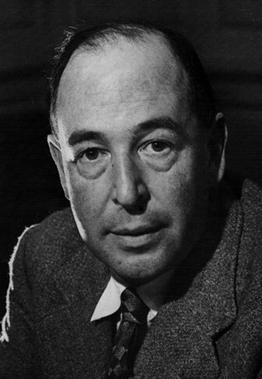
Monochrome head-and-left-shoulder photo portrait of 50-year-old Lewis

Clive Staples Lewis was born November 29, 1898 in Belfast, Ireland to Albert James Lewis and Florence Augusta Lewis. His father was a minister and his mother was a mathematician. However, his mother was not only good with numbers. She taught a

young Clive, who went by “Jack”, English and Latin from a young age. This would lay the foundation for his future career. His skills were honed at Malvern College, a boarding school he went to around the time his mother died. This education was halted by World War 1, when his studies at Oxford were paused. However, a war injury put Lewis back into the civilian sector, back at Oxford.

Early writings were largely unsuccessful, but Lewis’s mastery of allegory eventually brought him to prominence. “The Screwtape Letters” was his first success in 1926, followed by “The Chronicles of Narnia” in 1955, and many others. The connection between his most popular works is that they are all religious allegories. Following his

Image result for cs lewis

writing career, Lewis became an acclaimed professor at Cambridge University. In 1956, he married Joy Davidman Gresham, a woman from New York who had previously read his works. Sadly, she died 4 years after their marriage. Clives Staples Lewis died 3 years after her in Oxford, England on November 24, 1963.

Wormwood

In the book “The Screwtape Letters” by C.S. Lewis, a young demon is mentored by his experienced uncle Screwtape. Wormwood, the student exchanges letters with his uncle about his “patient”, a newly converted Christian, about how to lead him astray from the

good life. The name “Wormwood” is not just a random name. In real life, Wormwood is a plant with drug like qualities, a perfect connection to his task. As a new recruit, he has no experience with his “job”. We see him make many novice mistakes out of ignorance and negligence. Screwtape notices and asks him “-no one ever told you about the law of Undulation?” (Lewis 37). These weak areas could result in him failing in his mission.

These same qualities could be seen in an apprentice working with a mentor in some sort of a trade field. They have no previous experience, which could result in a failure in the project. The older, more experienced foreman is able to teach and help through the

process, eventually creating someone who is able to succeed him when the time comes. In the story, Wormwood would be the apprentice, while Screwtape is the mentor. Screwtape is looking for the “best” outcome for Wormwoods task.

The Screwtape Letters

The novel “The Screwtape Letters” by Clive Staples Louis is a collection of letters written from an experienced demon to his nephew, a younger inexperienced demon, about tips

The Screwtape Letters

for “securing” a man for “Our Father Below”. My first impressions of this book are that is very sarcastically written, giving the reader an uneasy kind of humor. The author uses this to draw attention to problems he sees in the world affecting his fellow Christians that are going astray. By addressing these problems in a lighthearted way, he is able to draw attention to problems without being too harsh or seemingly judgmental.

These early thoughts on this book are making me look for the tactics seen in the book in my own life, and look for these connections around me. This book condemns ideas such as drunkenness, violence, and impurity. I think that the

Screwtape Letters chapter 1

author might have been writing this book for specific people around him because of the specific cases Screwtape uses to advise Wormwood. Those cases seem to be rooted in a reality the author was living at the time of the writing. The way this story is written is from a partner of the devil, but it shows the evils of him and thus puts the reader on the side of “Him”

The Caesar Paradox

Julius Caesar was historically the end of democracy in Rome. By declaring himself permanent dictator, he had taken a formerly neutral title and given it a negative connotation. Having total power would allow tyranny to occur. Cassius took it upon himself to rid Rome of this threat. His first move was to employ Brutus, an Idealistic man, esteemed by many as the most honorable man. His reasons for joining were

Image result for caesar
Caesar

preventing abuses by the powerful Caesar, which outweighed his love for Caesar. Having Brutus’s support would persuade others on the fence to join the conspiracy; Caesar was abusing his power- killing him would be for the good of Rome.

When the time comes, and the Senators finally kill Caesar, the people are with the conspirators. However, when Marc Antony gives his speech at the funeral, the people start to turn on them. If the people hated them, but they were free, the conspirators would feel as though it was worth it. However, the people were riled by Marc Antony’s speech, and along with the other two members of the second triumvirate, Octavian and Lepidus, go to war against Cassius and Brutus. The chaos created from the

Image result for brutus

assassination of the dictator had led to 3 dictators in the end. The irony in this is that in the end, Brutus had only worsened the situation he was in by attempting to fix it. This resulted in Brutus losing his status, and eventually his taking of his life.

Sight vs. Scent- a look into hounds

Image result for greyhound

Since the dawn of time, man and dog have been living among each other, each side helping the other out. One major task that dogs helped to fill early on was helping in hunting. Developed for these tasks were sight hounds and scent hounds, dogs in the same family, but with very different strategies. The older of the two is the sight hound,

developed in the middle east over 5,000 years ago to hunt antelope and other plains creatures across vast expanses of field. The scent hound, however, was first used 3,000 years ago by the Celtics, tracking animals through thick forest and rugged terrain with dogged determination.

                Being able to catch something on the high plains would require speed; the lack of cover would make ambush impossible and prey sneaking away equally as hard. These ideas manifested themselves in early versions of dogs like the greyhound: great vision, muscular, but extremely lightweight- great at running short distances extremely fast, but

Image result for beagle hunting

couldn’t maintain it much longer than a mile, using their eyesight to direct them through the open expanses of the middle east. These characteristics contrasted the scent hound. These dogs were built sturdier, a trait that allowed them to not move as fast, but for much longer through steep territory easier, following their noses, which in turn were following the scent of their prey, with dogged persistence to wear down the game and eventually catch up to it. A common example of these is the Beagle, a dog renowned for its deep-rooted stubbornness. While both of these groups have the same goal, their methods are very different.

“Live Painting”

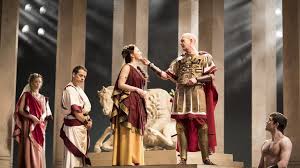
Today in class, we did an activity called a tableau vivant with “Julius Caesar”, where groups had to act out scenes, but couldn’t move. “Tableau vivant”, a French phrase, looks like it would mean “live tablet” from previous experiences with other languages,

but it literally translates to English as “live painting”. This would make sense as a painting has figures in it, but they are stationary. A “dead” painting can be made a live painting by putting live figures in replacement of 2 dimensional ones from canvas. This concept of having boundaries of what an actor could use to perform in this way reminded me of a mime, in that they cannot escape their imaginary boundaries. However, a mime is able to move, making it a complete opposite to the stationary tableau actor.

One thing that I found online that had roots in tableau vivant was the mannequin challenge. People in this challenge would freeze doing what ever they were doing and wouldn’t move, showing what is going on at the time for the person filming the scene. While the founders of the movement were likely unaware of this theatrical style, it still had many similarities that were seen used by individual athletes, their teams, celebrities, music artists, activists, and even politicians. While there is an argument that musicians could have previous theatrical experience, it is unlikely that most of these groups have any to speak of. This example gave me a more commonplace example of this theatrical style to give a better understanding of this activity.

Julius Caesar

Cassius:
“The fault, dear Brutus, is not in our stars,
But in ourselves, that we are underlings.”

Julius Caesar (I, ii, 140-141)              

Image result for julius caesar shakespeare"

I see this quote as meaning that Cassius trying to tell Brutus that problems are not caused by fate, but by personal choices. This differs from the superstition in the story such as the negativity of “the ides of March”, or the wrath of the gods. Cassius uses words like “our” and “ourselves” to give Brutus a sense of community in an attempt to get him to join his conspiracy to eliminate Caesar, before he becomes indomitable. He also uses words with positive connotations like “dear” and “stars” to try to use kindness to help him end the tyranny of Caesar. Another explanation for this quote is that human nature causes people to make certain decisions, not fate.

This quote can be used in more than one way. It can be a positive in the case of failure, meaning that one does not have to fight supernatural forces, only themselves to succeed, or before an attempt at something knowing that their skills are what will determine the outcome, not those outside forces. John Greene’s “The Fault in our Stars” has the two main characters diagnosed with cancer, knowing that death is inevitable. However, they act in a way as though they are separate from their fate. This gives a new perspective in that fate and personal choice are not opposite but, somehow interconnected in a way that fate gives some flexibility for personal choice.

Design a site like this with WordPress.com
Get started